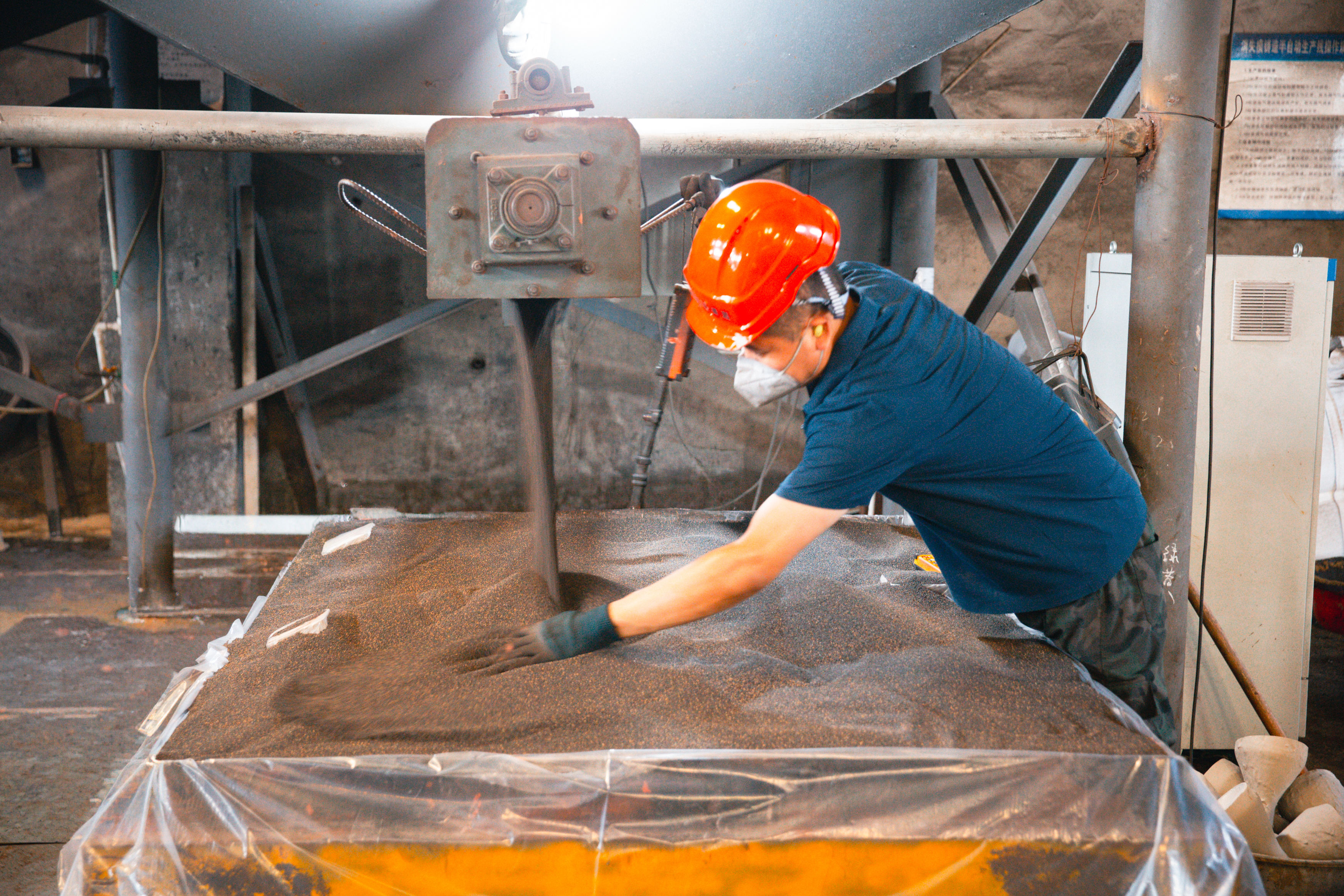
Two of the most widely used casting methods — sand casting and investment casting — serve very different purposes. Understanding their strengths helps you pick the right process from the start.
Sand Casting: The Versatile Workhorse
Sand casting uses a sand mold that is destroyed after each pour. It's the oldest and most versatile casting method, capable of producing parts from a few grams to several tons.
Advantages
- Low tooling cost — Patterns are inexpensive compared to metal dies
- Large part capability — Can produce castings up to 10,000+ kg
- Material flexibility — Works with virtually any castable alloy
- Short lead time — Prototype parts in 2–3 weeks
Limitations
- Surface finish: Ra 12.5–25 μm (requires machining for smooth surfaces)
- Dimensional tolerance: CT 11–13 (ISO 8062)
- Minimum wall thickness: 5–8 mm depending on material
Investment Casting: Precision at Scale
Investment casting (lost-wax process) creates a ceramic shell mold from a wax pattern. The wax is melted out, and molten metal fills the cavity. This produces near-net-shape parts with excellent surface finish.
Advantages
- Superior surface finish — Ra 3.2–6.3 μm, often usable as-cast
- Tight tolerances — CT 5–7 (ISO 8062)
- Complex geometries — Undercuts, thin walls, internal passages
- Minimal machining — Reduces secondary operations
Limitations
- Part size typically limited to under 50 kg
- Higher per-piece cost for simple geometries
- Longer lead time for tooling (4–6 weeks)
Head-to-Head Comparison
| Criteria | Sand Casting | Investment Casting | |----------|-------------|-------------------| | Part weight | 0.5 kg – 10,000 kg | 0.01 kg – 50 kg | | Surface finish | Ra 12.5–25 μm | Ra 3.2–6.3 μm | | Tolerance | ±1.5–3.0 mm | ±0.3–0.8 mm | | Min wall thickness | 5–8 mm | 1.5–3 mm | | Tooling cost | Low | Medium | | Unit cost (high volume) | Very low | Medium | | Lead time (first article) | 2–3 weeks | 4–6 weeks |
When to Choose Sand Casting
- Parts over 50 kg
- Simple to moderate complexity
- Cost-sensitive, high-volume production
- Materials like gray iron, ductile iron, or carbon steel
- Machining is already planned for critical surfaces
When to Choose Investment Casting
- Parts under 50 kg requiring tight tolerances
- Complex shapes that would be expensive to machine
- Stainless steel or alloy components
- Aesthetic parts where surface finish matters
- Medical, aerospace, or precision industrial applications
The Hybrid Approach
At Yuexian, we often recommend a hybrid approach: sand casting for the main body with investment-cast inserts for complex features. This optimizes both cost and precision.
Not sure which process is right for your part? Send us your drawings and our engineers will recommend the most cost-effective approach.